 Food Hygiene

 Free CPD Certificate on Completion

 Fire Safety
No products in the basket.


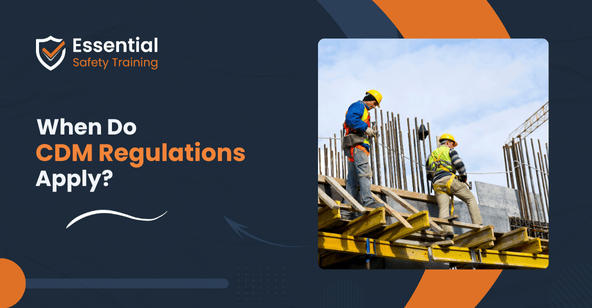
A common question arises when it comes to working in a hazardous environment like construction: when do CDM regulations apply? Construction is the most hazardous industry in the UK, with 51 worker fatalities in 2023-24 and an estimated 78,000 workers suffering from work-related ill health.
CDM (Construction Design and Management) Regulations 2015 are designed to manage the health and safety of everyone working on construction sites. Construction sites across the UK are required to comply with these regulations to ensure a healthy and safe work environment.
Our blog will help you get an extensive understanding of the CDM regulations. It will comprehend where they apply in construction work and provide many other useful insights. Explore more.
What Is CDM in Construction?
In the UK, the most common construction hazards include falls from height, which is the leading cause of fatalities. Other hazards include being struck by moving objects or vehicles. It also includes non-fatal injuries from slips, trips, or manual handling.
CDM in construction stands for Construction Design and Management. CDM in construction refers to the set of regulations that are created to ensure a safe work environment for everyone. These regulations apply to every type of construction work, no matter how small or large.

What are the CDM (Construction Design and Management) Regulations 2015?
The CDM (Construction Design and Management) Regulations 2015 are the UK’s main legal framework for managing the health, safety, and welfare of construction projects, covering all aspects from planning to completion.
CDM regulations place specific responsibilities on everyone working on site. It is to ensure that the projects are planned and managed safely to prevent hazards.
There are 5 key parts of the CDM Regulations 2015. It includes the following:
- Commencement And Application
This part details the scope and definitions of each CDM regulation. It includes the types of work and projects they apply to and any exceptions.
- Responsibilities of Duty Holders
This part elaborates on the specific duties of clients and other duty holders. Key duty holders like principal contractors, subcontractors, principal designers, and employers. They hold legal responsibilities for ensuring construction site safety.
- Health And Safety Duties And Roles
This part of the regulations includes duties and roles that work towards the health and safety of everyone working on-site. Monitoring the health of workers and evaluating the identified risks and potential hazards are part of it.
- General Requirements
This section provides rules and guidelines that apply to all construction sites. Ensuring the stability of structures and managing hazardous substances are an essential part of it.
- Arrangements And Schedules
This part provides additional guidance and lists specific requirements in five schedules. It includes details on who to notify the Health and Safety Executive (HSE) about. It also includes minimum welfare facilities and suitable arrangements.
These parts outline who is responsible for what and detail the rules for managing health and safety across all stages of a project.
When Do CDM Regulations Apply?
The definition of construction work under CDM covers every type of construction activity, no matter how small or large. The CDM Regulations 2015 apply to every construction work, including projects, maintenance, and other services.
Let’s take a quick glance at the type of activities that are included in construction work!

- Preparation for a structure,
- Site clearance and groundworks,
- Construction projects (small and large),
- Alteration, conversion, fitting-out, commissioning,
- Renovation, repair, upkeep, redecoration,
- On-site maintenance work,
- Demolition and dismantling of a structure,
- Installation of services, etc.
Every construction project is a CDM project, even when it’s minor maintenance work like renovation or decorating. Let’s understand the CDM Regulations 2015 and when they apply in construction work!
- CDM Regulations apply to all construction projects
The CDM Regulations apply to all construction projects, no matter how large or small the project is. The regulations cover a wide range of activities, including planning, design, and management. They are not limited to just the on-site construction itself.
Every industry or business involved in the construction project must adhere to the regulations. It is a legal requirement across all construction sites in the UK. You also need to notify the Health and Safety Executive (HSE) if your project lasts longer than 30 working days. Also, when your project has more than 20 people working on it at the same time.
- CDM Regulations apply to everyone involved in the projects
The CDM Regulations are applicable to everyone involved in projects and working on sites. It includes clients, principal contractors, subcontractors, principal designers, designers, managers, supervisors, employers, and even employees.
However, when there is only one contractor involved in a construction project, the CDM regulations are not a legal requirement. It still needs to be followed for construction site safety.
- CDM Regulations apply to both notifiable and non-notifiable projects
Under the CDM Regulations 2007, some non-notifiable projects were exempt from many of the CDM requirements. However, the CDM Regulations 2015 include non-notifiable construction projects as well.
A notifiable project is for high-risk projects that are more vulnerable to hazards and accidents. Other than that, non-notifiable projects also involve risks and potential hazards. In such cases, the CDM Regulations 2015 are applicable to all.
- CDM Regulations apply to domestic projects
The full requirements of CDM 2015 now apply to all construction work, including residential projects. It applies to domestic properties, with a key difference. The client’s duties are then passed to the principal contractor or designer.
Every construction project requires a Construction Phase Plan (CCP). It also requires risk assessment, pre-construction information, and CDM compliance. If the project has more than one contractor, then it must be developed by the principal contractor.
You also have to appoint a principal designer and a principal contractor for such projects.
When Do CDM Regulations Not Apply?
Even when the CDM regulations don’t apply to a project, the UK health and safety laws, including risk assessments, need to be followed.
Let’s have a look at some examples of construction work where the CDM regulations are not a legal requirement.
- Minor maintenance
Regular maintenance or repair of fixed plant that is primarily mechanical. Maintenance when it doesn’t involve building new structures or significant alterations. These aren’t necessarily included in the CDM Regulations.
- Non-construction activities
Routine site surveys, pressure washing, cleaning, fixed wiring inspections, and meter repair work. These are typically excluded from the CDM regulations.
- Minor projects (non-notifiable)
While the regulations still apply, the roles of principal contractor and principal designer may not need to be appointed. If there is one contractor involved in a single contractor project, the regulations are not always required.
However, minor projects that are non-notifiable are still required to follow the regulations.
- Projects outside of a construction site
Part 4 of the regulations, which deals with site rules, does not apply to maintenance work happening in an occupied building. It’s also not applicable to maintenance work outside of a construction site.
Ensuring Construction Site Safety under the CDM Regulations 2015
There are 9 key principles of prevention, which are an effective framework for health and safety in construction work. It emphasises avoiding risks, combating them at their source, and implementing control measures.

Let’s explore how these principles play a vital role in ensuring construction site safety!
- Avoid risks, accidents, injury, and potential danger
The first step is to eliminate potential hazards altogether. Identifying on-site hazards and potential risks to evaluate them is essential. It helps come up with effective preventive measures, which is of paramount importance here.
- Evaluate the risks which cannot be avoided
Assess the nature and importance of risks that can’t be fully eliminated to determine the best way to manage them. Preventing potential risks while minimising the existing ones is crucial here.
- Combat risks at the source
Deal with the hazard directly where it originates. For example, to avoid noise pollution, enclosing noisy machinery can be an effective initiative. Combating risks at their sources can not only minimise the risk but also prevent any foreseeable risk from happening.
- Adapt the work to the individual
Adjust the workplace and work design to accommodate the worker’s capabilities and limitations. It includes careful considerations when assigning tasks and alleviates a monotonous attitude. It also increases the overall work productivity.
- Adapt to technical progress
Stay current with new technologies to implement safer and more efficient methods. It’s crucial to make workers aware of and updated with the new technologies to boost their morale and overall progress.
- Replace the dangerous with the non-dangerous or the less dangerous
Replace hazardous materials, equipment, or processes with safer alternatives whenever possible. Having alternatives is not always an available option for many construction works. However, minimising the risks as much as possible should be the primary intention.
- Develop a coherent prevention policy
Create a comprehensive policy that integrates technology, work organisation and working conditions. It basically covers all aspects of prevention.
- Provide collective protective measures priority
Prioritise controls that protect multiple people (like guardrails or ventilation) over individual ones. An individual measure can be the personal protective equipment (PPE).
- Provide appropriate instructions to employees
Working in a hazardous environment like construction can often lead to fatalities. It also disrupts the mental well-being of workers and ruins their productivity.
CDM Regulations Training
Learn CDM Regulations to prevent hazards on sites & meet the legal duties with CDM Regulations training.
Enrol Today
It’s important to ensure employees receive proper CDM Regulations Training and relevant information on how to work safely on-site. CDM training helps workers fulfil their legal responsibilities better. Above all, it prevents construction site hazards and potential risks.
Frequently Asked Questions (FAQs)
What is the 20/20/20 rule in construction?
The 20/20/20 rule in construction work is for identifying hazards or any potential risk in the workplace. Every 20 minutes, workers take 20 seconds to look 20 feet around from their work area to identify any potential hazards or risks.
What is the difference between building regulations and CDM regulations?
CDM regulations are to ensure the health and safety of workers and anyone around the site during construction work. Meanwhile, building regulations are designed to ensure that the design and building work are safe. It also ensures its compliance with the Building Safety Act regulations.
Do CDM Regulations apply to maintenance activities?
Yes, the CDM regulations apply to maintenance activities. Construction design and management regulations apply to every type of construction work. It includes a wide range of tasks, including repairing, renovating, decorating, and many other types of maintenance work.
Conclusion
Understanding construction site safety and when do CDM regulations apply is a crucial part of working on sites. The CDM Regulations 2015 are for ensuring a safe work environment and preventing on-site hazards.
Regardless of the type, size, duration, structure, or scope of the construction project, it needs to comply with the CDM regulations. They are also applicable to every duty holder working on site and responsible for ensuring safety.
These regulations outline the legal duties of everyone involved in a construction project. It includes everyone from clients and contractors to designers and workers.
Essential Safety Training

At Essential Safety Training, we deliver a blend of online courses on safety and compliance. As a top-notch award-winning platform in the UK, we value learners and keep our commitment by creating more accessible, expertly crafted courses.