 Food Hygiene

 Free CPD Certificate on Completion

 Fire Safety
No products in the basket.


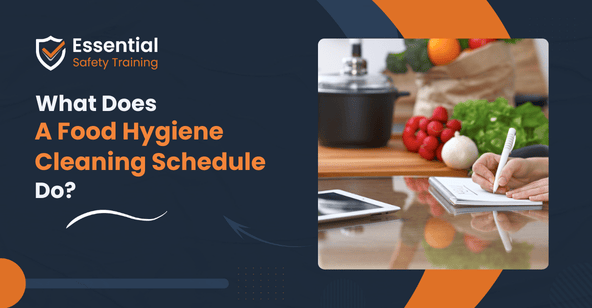
Around 2.4 million cases of foodborne illness occur every year due to a lack of proper food hygiene. While 90–96% of food businesses are compliant with safety standards, 33% of consumers report not washing their hands after handling raw meat, and 65% have stored food past its use-by date.
This brings us to the need for a proper food hygiene cleaning schedule in every food industry across the UK. A food hygiene cleaning schedule not only ensures hygiene and food safety but also ensures compliance with food safety regulations, such as the HACCP.

Here, we will help you understand the need for a food hygiene cleaning schedule and how it ensures food safety and protects consumers from foodborne illnesses. Discover more.
What is a Food Hygiene Cleaning Schedule?
When it comes to the food industry, sanitation is one of the essentials for ensuring the utmost food safety and quality. A food hygiene cleaning schedule is a documented, organised schedule of how, when, and by whom food preparation areas and equipment are cleaned and disinfected.
Every food business must include a food hygiene cleaning schedule template that plans, assigns, and verifies cleaning tasks, reduces food risks, and ensures compliance. It will make sure that the entire process of food preparation and service is done in a clean and sanitary way.
It will also protect against potential food contamination and transmission of foodborne diseases, and protect the health of consumers. It is a careful process which requires paying serious attention to many aspects of food hygiene and safety.
What does a good food hygiene cleaning schedule include?
A good food hygiene cleaning schedule would encompass the nature of food handling operations, the amount of traffic, and the special health codes and regulations that apply to the food business safety standards.
An effective and compliant cleaning schedule must have a couple of non-negotiables. Here’s what to include:
- List of everything to be cleaned (surfaces and areas, like fridges, floors, slicers, sinks).
- The rate at which each cleaning activity is to be done hourly, daily, weekly, or monthly.
- The individual in charge, be it through name or job title.
- Specific cleaning protocols, the type of chemicals, and the use of PPE (Personal Protective Equipment).
- Sign-off section to record the completion (initials, date and time).
- It can be done on paper, a spreadsheet or by digital apps, but ensure it is available and regularly updated.
Areas to Cover
Level 2 Food Safety and Hygiene for Business
Master Food hygiene laws and keep your business safe with our Level 2 Food Safety and Hygiene.
Enrol Now
Standard areas that should be incorporated are:
- Work station and chopping board.
- Freezers, fridges and storage spaces.
- Ovens, grills & hobs
- Sinks, taps & drains
- Floors, walls & ceilings
- Handwashing stations
- Minor equipment – consider food processors, blenders, and scales.
- Other areas that are less obvious, such as light switches, door handles and splashbacks must also be covered.
Colour-coding and Labelling
Colour-coding will assist in preventing cross-contamination as well as determining your cleanliness rate. It helps with the following:
- Red for raw meat zones
- Blue for shellfish/seafoods.
- Salad and washed veg prep areas are green.
- Yellow for cooked meats
- It minimises the chances of cross-contamination and assists new employees in picking things quickly.
Cleaning Strategies
The strategies of cleaning should not be limited to the general cleaning procedures in food premises, particularly those dealing with high-risk or ready-to-eat foods.
It should include the ‘Zoning Method’, which is the separation of the facility into various areas depending on the contamination risk. The strategy will prevent cross-contamination of the raw materials, processing, and finished product areas.
| Zone Description & Example Areas | Cleaning Focus |
| Zone 1: Direct food contact surfaces | Conveyor belts and cutting tables require regular cleaning and disinfection. |
| Zone 2: Immediate to food contact areas | Equipment frames and switches require regular cleaning with allergen/pathogen control. |
| Zone 3: Processing areas | Non-food contact surfaces, floors, walls and drains require regular cleaning to control the environmental hazards. |
| Zone 4: External/support areas | Breakrooms, loading docks, and offices. It’s low risk but requires observed cleaning. |
Your zoning plan should be supported by staff training, signage and tool storage protocols in order to achieve a consistent execution.
Why Do You Need a Food Hygiene Cleaning Schedule?
The schedule of food hygiene cleaning is necessary to provide safe preparation of food, eliminate cross-contamination, and make sure that the food safety regulations are observed by law.
It serves as an organised, written manual, which defines what is to be cleaned, and when and by whom, thus preventing the dangers of food poisoning, pest attacks, and expensive and unsuccessful inspections to a great extent.
Level 3 Food Hygiene and Safety
Ensure compliance and protect public health with our Level 3 Food Hygiene and Safety training.
Enrol Now
Let’s understand why we need a good food hygiene cleaning schedule for food businesses!
Prevention of foodborne illness
With regular, planned cleaning, harmful bacteria (like Salmonella, E. coli), allergens, and physical hazards are removed from surfaces, equipment, and utensils.
Ensures legal compliance
There are laws such as the Food Safety Act 1990 that stipulate that food businesses must be in a state of high cleanliness and present records (such as a cleaning schedule) to Environmental Health Officers (EHOs).
Less cross-contamination
A schedule will make sure, say, that preparation areas of raw meat are not used with ready-to-eat food, which will expose customers to contamination.
Creates accountability
A cleaning schedule is the best way to create accountability, as the staff is aware of their duties and will ensure that a task does not get lost.
Enhances safety and productivity
It minimises the chances of pest infestation and, through maintenance of clean extraction systems, minimises the chances of fire.
Keeps the standards high
Scheduled, frequent cleaning would provide a high level of hygiene setting that ensures improvement in the quality of food and elevation of hygiene ratings.
Is it a legal requirement?

A food hygiene cleaning schedule is a legal requirement for all food businesses across the UK under the Food Safety Act 1990. Every food business should have a food safety management system (FSMS) that is founded on the principles of HACCP.
A documented cleaning schedule is evidence of due diligence in keeping the environment safe and clean. The key requirements of the Food Safety Act 1990 include the following,
Legal Foundations
Operators of food businesses are expected to make certain that the facilities are properly maintained in order to avoid contamination. Poor hygiene is among the major causes of prosecution.
HACCP Compliance
A written, actionable, and verified cleaning schedule is an essential part of Hazard Analysis and Critical Control Point (HACCP) rules, which proves an active presence of safety control.
What it should contain
The schedule should specify what, when and how (methods), and who will do the cleaning; the chemicals that will be used.
Two-Stage Process
The UK rules demand a two-step cleaning process (cleaning to get off the dirt, and disinfection). You can also appeal the food hygiene rating of your food business to build reliability among your consumers.
Consequences
Not following a cleaning schedule may lead to legal proceedings, huge fines, shutdown or even a jail sentence.
How to Make a Food Hygiene Cleaning Schedule? A Step-by-Step Guide
The first step to designing an effective food hygiene cleaning schedule is to list all the areas and equipment which require cleaning and assign the frequency (hourly, daily, weekly, etc.).
It should also include the cleaning methods, the required chemicals and personnel to perform all the cleaning. Arrange the plan in simple and sequential steps, such as clean, then disinfect in food contact surfaces and a sign-off section to ensure compliance.
Complete Food Hygiene and Safety Bundle
Learn the essentials of food safety and gain skills with our Food Safety Masterclass Bundle.
Enrol Now
Let’s take a look at the following steps to make a good food hygiene cleaning schedule!
Step 1: Identify All Items
Inspect your premises to include all surfaces, equipment, and structural components (like floors, walls, and drains).
Step 2: Establish Frequency
Cleaning tasks should be allocated depending on the need of the task; some tasks need to be taken care of daily, weekly or monthly.
Step 3: Give Instructions
Indicate the method of doing each item, what chemicals (like detergent or sanitiser) to use, what equipment to use and what safety measures (PPE).
Step 4: Delegation
It should be clear who is supposed to perform which task and who will hold accountability in each task to make sure that jobs are fully performed.
Step 5: Add Sign-off
Must have a checklist that the staff initial and date at the end of the task, and act as a record of compliance during environmental health inspections.
Step 6: Typical Structure
- Daily: Clean food-prep surfaces, equipment, sweep/mop floors, empty bins and clean toilets.
- Weekly: Deep clean ovens and clean walk-in fridges, and also clean out storage areas.
- Monthly/Periodic: Clean high-level walls, ceilings, and vent systems.
Step 7: Best Practices
Here are some of the best practices you can follow to have a proper food hygiene cleaning schedule!
Colour-Code
High-risk areas should be used with different colored cloths and equipment to avoid cross-contamination.
Periodical Inspection
Check the cleaning being done on schedule regularly and make changes on a schedule where necessary.
Available Formatting
Have the schedule in a convenient, visible place (paper or computer).
How does HACCP, a Food Safety Management System, help?
HACCP (Hazard Analysis and Critical Control Point) makes cleaning an activity more focused as a risk-oriented safety measure and not a general one.

It is beneficial because it finds the high-risk zones (Critical Control Points) that should be sanitised with a particular frequency, ensures that cleaning agents are not contaminated, and provides documented and verifiable evidence of the hygiene standards.
Risk-Based Cleaning
HACCP does not clean all surfaces and equipment equally, but instead it identifies the surfaces and equipment that are at the greatest risk of being contaminated with microbes, chemicals, or allergens (such as raw meat cutting boards).
Establishing What, When and Who
HACCP contains schedules that are as detailed as possible: what item is to be cleaned, how often it must be cleaned (hourly, daily, weekly, etc.), what chemical is to be used, what the dilution rate is, and by whom.
Setting of Critical Limits
Cleaning should be structured to have a certain standard, i.e. to have equipment which is visually clean and disinfected to a reasonable level to prevent cross-contamination.
Checking and Documentation
HACCP makes employees sign the cleaning operation, which results in evidence in the form of a document that procedures are being accomplished, which will be critical during audits and assurance of food safety standards.
Corrective Actions
In the event that a cleaning check is not passed (such as a surface being dirty), the HACCP plan spells out corrective actions (like re-cleaning and sanitising the equipment before it is reused).
Learn more about HACCP and what it does in food safety.
Frequently Asked Questions (FAQs)
Which items must be cleaned every 4 hours?
To ensure food safety, some items need to be cleaned and sanitised every 4 hours. These include all food-contact surfaces, utensils and equipment, high-touch surfaces, and cleaning tools.
What four things must be included in an effective master cleaning schedule?
An effective master cleaning schedule must include the four key elements. These are detailed cleaning tasks, specific frequencies for each task, assigned responsibilities for staff, and methods for documentation.
What are the 5 C’s of food safety?
The 5Cs of food safety are Clean, Cook, Cross-contamination prevention, Chill, and Check. These food safety practices are essential to prevent foodborne illnesses or any food-related hazards.
Conclusion
The importance of a properly maintained environment in food operations cannot be overestimated. It has a direct effect on the health of the people and the quality of the food delivered. The need for a food hygiene cleaning schedule is a must for every food industry.
The cleaning schedule should include all spheres of operation, including the preparation and cooking zones, storage, dining and waste disposal zones. Every single area needs a specific cleaning approach, considering the frequency of use, the kind of food managed, as well as the risks that may be involved with each space.
A proper cleaning plan is, thus, not only a procedural requirement but also a primary element of operational excellence. This will be aimed at establishing a balanced harmony between completeness and cost-effectiveness, as well as ensuring that every area is well cleaned.
Essential Safety Training

At Essential Safety Training, we deliver a blend of online courses on safety and compliance. As a top-notch award-winning platform in the UK, we value learners and keep our commitment by creating more accessible, expertly crafted courses.