 Food Hygiene

 Free CPD Certificate on Completion

 Fire Safety
No products in the basket.


In the UK, the Health and Safety Executive (HSE) estimates that around 1.7 million workers report suffering from a work-related illness, which can include conditions like asthma and dermatitis caused by exposure to hazardous substances.
Workplaces use a wide range of substances and chemicals that are dangerous to health and the environment. Learning about hazardous substances symbols and their meanings can help you identify potential threats. COSHH hazard symbols are globally standardised and regulated by the UK health and safety law.
In our informational guide, you can learn the crucial information you must know to work in places that use hazardous substances. COSHH hazard symbols, regulations, risk assessment, etc., will be discussed here. Explore more.
What Is a Hazardous Substance?
A hazardous substance refers to any material, chemical, or substance that causes harm, risk, or hazard to the health, environment, or any other properties/facilities. A mixture of two different chemicals can also lead to a new substance that is dangerous.
Hazardous substances occur in many forms, such as chemicals (including both solid and liquid chemicals or mixtures), gases, dusts, fumes, liquids, vapours, mist, nanomaterials, and biological agents. Acute and chronic diseases such as respiratory disease, skin disease, allergic conditions, infections (e.g., bacterial pneumonia), cancer, or even death can happen.
In our work with harmful materials and their regular use, two of our major environmental awareness concerns are health and safety.
What Does COSHH Do?
COSHH is an acronym that stands for Control of Substances Hazardous to Health. It is an essential part of UK health and safety law that aims to ensure that employees are not exposed to harmful chemicals. COSHH covers a wide range of chemicals, substances, or any other material that is dangerous.
COSHH is an essential aspect of workplace health and safety. It has various functions, like conducting risk assessment, implementing appropriate control measures, providing required training, instructing on recognising hazards, etc. Besides these, it ensures legal compliance of employees and employers with UK COSHH regulations.
Which Hazardous Substances Does COSHH Cover?
COSHH covers the following materials that are hazardous to health and the environment. Let’s have a look at them!
- Chemicals and products containing chemicals, liquids, solids, etc.
- Fumes, dust, vapours, mists, welding fumes, sanding dust, etc.
- Gases, simple and asphyxiating gases
- Biological agents such as pathogenic germs and other disease-producing microorganisms, e.g., bacteria, fungi, and viruses.
- Nanotechnology or nanomaterials that are toxic
- Naturally occurring materials which are likely to be harmful and are environmentally harmful, e.g., grain dust, silo gases, etc.
But there are some materials that have not been included by COSHH, like asbestos, lead, and radioactive products that are equally harmful and dangerous to health and the environment.

Hazardous Substances Symbols and Their Meanings
In the current society, health and safety in workplaces are a large concern for all. Knowing hazard symbols and their meaning allows employers, employees, and anyone else to identify potential hazards.
What Is a Hazardous Substance Symbol?
A hazard symbol for a substance is a pictogram that makes it easy for you to detect potential hazards related to workplace substances or chemicals. Such materials can pose health risks as well as environmental risks.
Hazard symbols offer an easy, graphical way of knowing the main dangers from a chemical product, including physical hazards (such as being a fire risk) and health risks (such as being toxic to the environment).
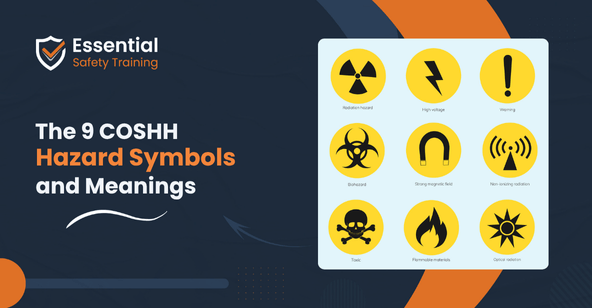
The 9 COSHH Hazard Symbols and Their Meanings
High-risk substances covered by COSHH are categorised into the following nine different types.
- Explosives,
- Flammable,
- Oxidising,
- Corrosive,
- Toxic,
- Gases under pressure,
- Health hazards,
- Serious health hazards, and
- Dangerous for the environment.
Let’s get into the elaborated meanings and the kind of threats these harmful substances represent!
- Explosives
The explosives hazard symbol is a pictogram of an exploding bomb and represents chemicals or substances that explode.
What does the sign mean?
- Unstable or unpredictable explosion,
- Mass explosion and severe projection hazard,
- Fire, blast, or projection hazard, and
- Mass explosion in fire or other explosive materials.

- Flammable
The hazard symbol is a flame that indicates chemicals or substances that can catch fire in contact with air or any ignition source.
What does the sign mean?
- Flammable and extremely flammable gases,
- Flammable liquid and vapour,
- Flammable solid, and
- Flammable aerosols, perfumes, or any other flammable material.

- Oxidising
This hazard sign is a pictogram of a flame over a circle. It conveys the danger chemicals pose when they react exothermically with other chemicals or substances.
What does the symbol mean?
- Oxidisers may cause or intensify fire, and
- Strong oxidisers cause fire or explosion.

- Gases Under Pressure
The hazard symbol is a gas cylinder. You can find this hazard symbol on gas containers.
What does the symbol mean?
- Gases under pressure may explode under extreme heat, and
- Refrigerated gas may cause cryogenic burns or injury.

- Corrosive
The pictogram for corrosive hazards shows corrosion of skin and other materials. Corrosive chemicals or substances can damage living tissue when in contact.
What does the sign mean?
- Corrosive chemicals can be found in drain cleaners, acetic acid, hydrochloric acid, ammonia, etc.
- It can be corrosive to some kinds of metals, and
- It causes severe burns to the skin and can cause eye damage.

- Toxic Substances
The hazard symbol for toxic substances is a skull and crossbones. It causes fatal and non-fatal damage to health.
What does the sign mean?
- Toxic materials are fatal when in contact with the skin, and
- It can cause health damage if swallowed or inhaled.

- Health Hazards
The health hazard symbol is a pictogram of an exclamation mark. This sign represents mild to severe damage to health.
What does the symbol mean?
- Substances that cause harm to health, such as respiratory irritation or damage
- It can cause infections if swallowed, inhaled, or in contact with the skin
- Skin diseases or allergies
- Skin and eye irritation
- Drowsiness or dizziness, etc.

- Serious Health Hazards
A serious health hazard has a different symbol from the health hazard symbol. It shows a person with damage and represents materials that cause long-term diseases or illnesses.
What does the sign mean?
- It causes severe and fatal damage to the organs.
- Causes organ failures, genetic defects, respiratory damage, asthma, cancer, or other long-term illnesses.
- Suspected of damaging fertility or the unborn child.

- Dangerous for the Environment
The symbol for environmentally high-risk substances is a dead tree and a fish. It indicates immediate or delayed danger or risk to one or more components of the environment.
What does the symbol mean?
- These are very harmful to aquatic life with long-lasting effects, and
- It can cause severe or fatal damage to the environment by destroying the ozone layer in the upper atmosphere.

The Importance of Understanding the COSHH Hazard Symbols
The COSHH hazard symbols provide visual alerts to risks and hazards. Simply put, these hazard signs provide an immediate notification of dangerous items in workplaces.
Let’s discover the core reasons why we need the COSHH hazard symbols in workplaces!
- Communicates risk and potential hazards clearly
Hazard symbols are a standardised and organised way to communicate risks and potential hazards effectively. It doesn’t have any barriers of language; the signs are internationally recognised for any worker or individual to understand what they mean. Communicating the signs in vulnerable workplaces is a crucial aspect to ensure safety.
- Alerts employees and employers to health hazards
Hazard signs indicating health risks and serious health risks allow individuals to understand the potential danger they are exposed to by touching dangerous chemicals. Signs for health hazards express health risks such as skin disease, allergies, infection, etc.
On the contrary, serious health hazard symbols warn of long-term hazards associated with respiratory harm, asthma, chronic disease, cancer, and death. It urges workers to use Personal Protective Equipment (PPE) to lower the risk and protect themselves.
- Prevents accidents, injuries, and potential risks
Hazard symbols warn workers of high-risk materials that can cause accidents or severe injuries. With the help of such signs, they handle them with careful consideration. It helps them prevent workplace hazards like fatal accidents, injuries, or even non-fatal ones. It also helps prevent the potential risks.
- Alerts individuals to minimise the use of hazardous substances
Minimising the use of and exposure to harmful materials not only protects the health of living beings but also protects our environment.
Hazard symbols that are designed to convey the risks they pose to health and the environment also help protect the environment. It guides individuals to safe disposal and handling practices that prevent fatal damage to the environment.
- Ensures legal compliance with the UK health and safety laws
The COSHH Act is a requirement in law, and an awareness of the COSHH hazard symbols is an integral part of it. It is an integral component of meeting the health and safety legislation and making the workplace safe.
You can also take essential COSHH training to learn valuable information about COSHH hazard symbols, workplace risk assessments, identification of hazards and harmful substances, etc.
COSHH Training Course
Ensure workplace safety and COSHH compliance with our CPD-accredited COSHH Training.
Start Today
Frequently Asked Questions (FAQs)
Do all chemicals use COSHH hazard symbols?
Not all chemicals use COSHH hazard symbols. There are nine hazard symbols in COSHH under the Globally Harmonised System (GHS). Substances or chemicals that are dangerous use hazard symbols. Some chemicals don’t use any hazard symbols or signs, depending on the threats they pose.
Where do you find these hazard symbols?
You can find hazard symbols in places that use high-risk chemicals or materials frequently. Hazardous substances can be found in many work industries, including labs, construction, manufacturing industries, agriculture, cleaning and maintenance, healthcare settings, etc. You can find hazard symbols in these environments to alert people about such substances.
Why do some products have multiple symbols?
Some products have multiple symbols depending on the kind of threats they pose. It conveys important information about product safety, the kind of hazard they pose, manufacturing practices, composition (ingredients, allergens), etc. They also include instructions on post-use for recycling purposes.
Conclusion
When it comes to working with hazardous substances or in workplaces that use harmful substances, knowing the essentials is of paramount importance. Hazardous substances symbols and their meanings play a vital role in identifying potential hazards.
COSHH law is in place to protect health and safety at work and keep you legally compliant. This includes managers, supervisors, health and safety staff, or anyone who is designated with the control, prevention, and reduction of health hazards at work. You must have training and competence to undertake the work for which you have been appointed.
Anyone who works with chemicals or materials that are harmful to health or completes risk assessments must be familiar with COSHH hazard symbols and their significance. This knowledge will help to limit the use of and exposure to materials that have high risk, as well as to know the higher-order hazards and chemicals.
Essential Safety Training

At Essential Safety Training, we deliver a blend of online courses on safety and compliance. As a top-notch award-winning platform in the UK, we value learners and keep our commitment by creating more accessible, expertly crafted courses.