 Food Hygiene

 Free CPD Certificate on Completion

 Fire Safety
No products in the basket.


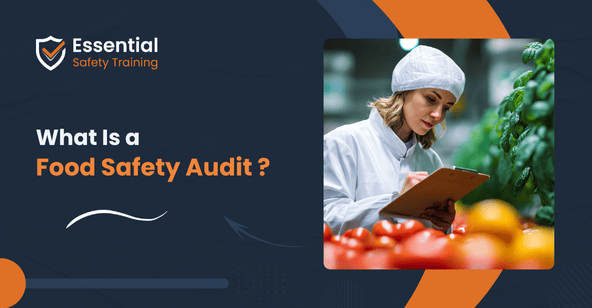
Just think of a running business where everything looks fulfilling. It features clean counters, fresh ingredients, a clean environment, professionally dressed staff, and fully satisfied customers. But behind the picture, how are you sure your food is truly safe to eat?
For that reason, a food safety audit question comes here. The key question is, what is a food safety audit? A Food safety audit is a continuous check of a food business to ensure the food is safe to eat. It ensures that food is prepared, stored, and served properly.
In this blog, you will learn about the importance of food safety audits, types, purposes, and the entire process you need to know. Let’s dive deep.
What is a food safety audit?
A Food Safety Audit is a systematic, independent investigation of the food business operation, process, and system in order to check whether they adhere to the set food safety laws, standards, and procedures.
Put more simply, it is a thorough inspection and assessment to make sure that food can be handled, produced, and stored in a manner that will not contaminate or cause any diseases to the consumers.
A modern food safety risk assessment audit guides how well a company’s food safety management system is performing, not only if rules are followed, but also how effectively they are implemented to prevent contamination.

Why are food safety audits important?
The purpose of a food safety audit is to assist in maintaining the quality of food products as well as their safety and regulation by the laws and industry standards. The following are the key reasons why these audits are important:
1. Protects Consumer Health
The main aim of a food safety audit is to reduce foodborne diseases by identifying and eliminating the possible risks and uncertainties (biological, chemical, or physical) in food production, handling, and distribution.
2. Ascertains Regulatory Compliance
Audits help companies in meeting the governmental requirements or international regulations like HACCP, ISO 22000, or GFSI. Regular audit minimises the chances of fines, penalties.
3. Maintains Brand Reputation
Incidents of food safety may have a negative image and reputation of a company and on consumer confidence. Regular audits ensure quality and safety commitment, which boosts brand image and loyalty.
4. Determines Areas of Improvement
Audits indicate food safety areas of weakness in the management systems. They give practical knowledge on how to improve continuously, minimise waste and errors, as well as operational uncertainty.
5. Gains Customer and Partner Trust
It provides proven audits by a third party undertaken by retailers, suppliers, and partners to conduct business with them. Auditing achievement is a sign of reliability and professionalism, and this would open up new markets and partners.
Level 2 Food Safety for Business
Keep your business safe and compliant with our Level 2 Food Safety and Hygiene for Business.
Enrol Now
What are the types of food safety audits?
There are mainly two types of food safety audits. The first one is an internal audit, and the second one is an external audit.
1. Internal Audit
An internal audit in food safety is an assessment done internally to the organisation by the organisation’s own trained staff (or in some cases, outsourced internal auditors) to verify that the food safety management system is operational. Carried on by the own expert staff of the organisation.
Purpose: To assess obedience to internal food safety systems and continuous improvements that are possible before external audits. It helps keep on improving, and certification or inspection readiness.
2. External Audit
External Audits are conducted by parties outside the organisation to provide independent evaluation and expertise in food safety compliance.
a. Regulatory Audit
Regulatory or government authorities perform this type of audit.
Purpose: To enable compliance with legal food safety regulations.
Ex: Food Standards Agency, inspection of the Health department, FDA/EFSA inspections.
b.Third-party Audit:
Third-party audit is carried out by independent auditing or certification bodies not directly related to the organisations.
Purpose: To ensure adherence to the accepted food safety standards.
c. Customers / Suppliers Audit
It is performed by the customers on their suppliers or manufacturers.
Purpose: To ensure that suppliers satisfy the customer’s specific food safety and quality needs.
The purpose of the food safety audit
A food Safety audit is aimed at ensuring that a food is always in compliance with regulatory and industry standards. It gives an objective evaluation of food handling procedures, hygiene, and management systems to certify that they meet requirements like HACCP or ISO 22000.
In addition to compliance, audits can assist in the identification of possible risks, increase the efficiency of operations, and increase the overall culture of food safety. Through continuous audit, compliance safeguards, customer improve the quality of their products and their brands.
Food safety audit process
The Food Safety Audit Processes are mainly:
1. Planning
Planning means designing the audit, outlining the scope, objectives, as well as the schedule. To make effective preparations, choose competent auditors and review audit findings of the past.
2. Setting the standards
The authority should set the food safety standards or regulations to be used, such as ISO 22000, HACCP. These will enter into evaluation for benchmarking.
3. Execute Audit
The audit should be guided by observation of the operation, reading documents, and interviewing the staff member, and then the audit should be executed.
4. Compared the audit result with the standards
Identify non-conformities, the causes of non-conformity, and adopt corrective and preventive measures to remove the problems and avoid repetitions.
5. Corrective and preventive actions
If necessary authority will take corrective action and go into the verification steps.
6. Verification
Ensures all the corrective steps taken are well-performed and sustained.
7. Reporting and Documentation
List and report all audit findings, decisions, and recommendations for continuous improvement and future reference.
8. Audit monitoring & evaluation
Finally, carry out the audit on a regular basis as a continuous improvement process to maintain uniformity in food safety.

What are the 7 principles of food safety?
The 7 principles of food safety are fundamental guidelines aimed at ensuring that the food we eat is safe and free from contamination. These principles form the backbone of food hygiene and public health practices.
1. Identify possible hazards
Those principles begin from finding every point within the food process, and where biological, chemical, or physical hazards may occur and require control.
2. Identify the control steps
Then identify the right steps or areas in the process that you will have to exercise control over to control or minimise a hazard to safe levels.
3. Executive threshold values
Means setting measurable boundaries (such as temperature, time, pH, water activity) that are to be achieved to guarantee safety for every critical control point.
4. Check the critical points
Firstly, maintain compliance at each CCP, then establish who, how, and when each critical limit will be checked.
5. Provide corrective action in case of something going wrong
If there is a variation from a critical limit, establish corrective measures to ensure that consumers do not receive unsafe food.
6. Check the effectiveness of the system ( Periodically review the system)
A food business should conduct some activities periodically, review records other than the regular monitoring, to verify the effectiveness of the system.
7. Keep detailed records and documents
Finally, it should maintain detailed records of hazard analysis, CCPs, critical limits, monitoring, corrective action, verification procedures, and other details of the HACCP plan for proper control.
What is the difference between a food safety audit and an inspection?
- Food Safety Audit
It means a planned, systematic investigation of the entire food safety management system ( like HACCP, ISO 22000) for checking sustainable compliance and improvement. It focuses on documentation, production procedures, the storage system, and overall effectiveness.
- Food Safety Inspection:
It mainly focuses on a routine or unannounced check of real operations to ensure immediate compliance with food safety and hygiene rules. It also focuses on daily practices, cleanliness, and legal requirements.
What are the 5 C’s of food safety?
It is important to ensure that food is handled, prepared, stored, and served properly to prevent foodborne diseases and many other unsafe issues. When the question is about food safety, there is a simple rule, which environmental health responsibility of environmental health. The Directorate has formulated under the umbrella term of 5 C’s: Check, Chill, Clean, Cook, and Cross-contamination.
What common mistakes are found in food safety audits?
There are many mistakes that are found during the food safety audit process. The most common mistake which we see:
- Poor documentation: If there is no documentation or outdated documentation, it may create a lack of traceability.
- Poor hygiene behaviours: If there is a poor handwashing system, contaminated equipment, or a cross-contamination process, it may create less hygiene behaviour.
- Problems with temperature: Improper storage, cooling, or heating of temperature problems are also found at the time of auditing.
- Pest issues:There are indications of pests, bad pest management records, and open access points. Those problems are also found in auditing time.
- Staff training deficiency: Means there is no or insufficient food safety allergen training.
- Allergen control failures: Mislabeling, cross-contact, and no allergen plan.
- Weak HACCP plan: Inexpecified or unconfirmed hazard analysis.
- Poor maintenance: There remains a mismatch between operations and maintenance, like broken or irreparable equipment, and calibration problems.
- Wrong storage/handling: Not using FIFO, unlabeled, or expired.
- No corrective action: It means ignoring issues or repeating past non-conformances, and the business does not take any preventive steps.
Tips for improving food safety audits
In order to increase food safety audits, the authority has to keep full and recent records, making sure that all the procedures and monitoring logs are up to date and correct.
Regular staff training ensures that everybody is skilled in food safety procedures and proper hygiene. The audit will aid in identifying the problems, and regular checking will help avoid the risk of contamination.
Food safety is also enhanced by monitoring the storage and cooking temperature, addressing the control of allergens, and implementing effective pest management measures.
Frequently Asked Questions
1. Who comes under the food safety audit?
Several individuals are involved in a food safety audit, such as auditors who have their activities examined, managers who supervise the operations, production staff who work with food and maintain the standards, suppliers when their materials or services are involved, and sometimes regulatory inspectors to ensure legal compliance.
2. What happens if a business fails a food safety audit?
If a business fails to comply with food safety audit procedures, it may lose customer trust and business reputation. It may also lose customers, which can have a negative impact on the business’s finances and long-term stability. All these reasons will become causes of an existential crisis for that business in the future.
3. What is the software that is utilised in food safety audits?
The main software that you will use for food safety audits is:
Safefood 360: HACCP and compliance management, SafetyChain: Real-time audit and quality control, Intelex: Automated audit reports and risk tracking, EtQ Reliance:
Food safety document control Software, FoodLogiQ: Traceability and supplier management.
4. What are five of the food safety guidelines?
The 5 food safety guidelines are as follows:
1. Everyone should maintain good hand hygiene.
2. Avoid cross-contamination of raw and ready-to-eat food.
3. Examine the package against dents or leaks.
4. At the time of cooking, there should be a food temperature checker.
5. Ready-made products should be put quickly under refrigeration.
Conclusion
In simple terms, what is a food safety audit? It means a fitness check-up of a food business. It tests all the steps of storage to production, to serving, to ensure that the food is safe to eat and that it complies with all the safety measures.
Audits are necessary for protecting and keeping customers, staying compliant with regulations, maintaining a good reputation, and spotting areas that need improvement. Audits can be internal, external, or conducted by regulators, suppliers, or third parties.
The audit process involves planning, inspecting operations, reviewing documents, and monitoring results. Through such types of audits, one can identify problems, solve the problems, and earn customer acceptance by ensuring they remain healthy, safe, and satisfied.
Essential Safety Training

At Essential Safety Training, we deliver a blend of online courses on safety and compliance. As a top-notch award-winning platform in the UK, we value learners and keep our commitment by creating more accessible, expertly crafted courses.